Radar

Radar

Carefully reported stories from AI coding talks, posts, and official notes, with the original source in view.

Three trays of blank cards connected by a dark rail and an orange bead.

YouTube

What coding tools can teach office agents

In a talk published by AI Engineer on 3 September 2026, Composio cofounder and CTO Karan Vaidya argues that coding agents moved faster because of six supports around the model — a shared place to work, a record you can inspect, local standards, checks before effects, walls outside the prompt, and undo — not because the model itself is enough. Knowledge-work agents, he says, still have to operate without most of that support.

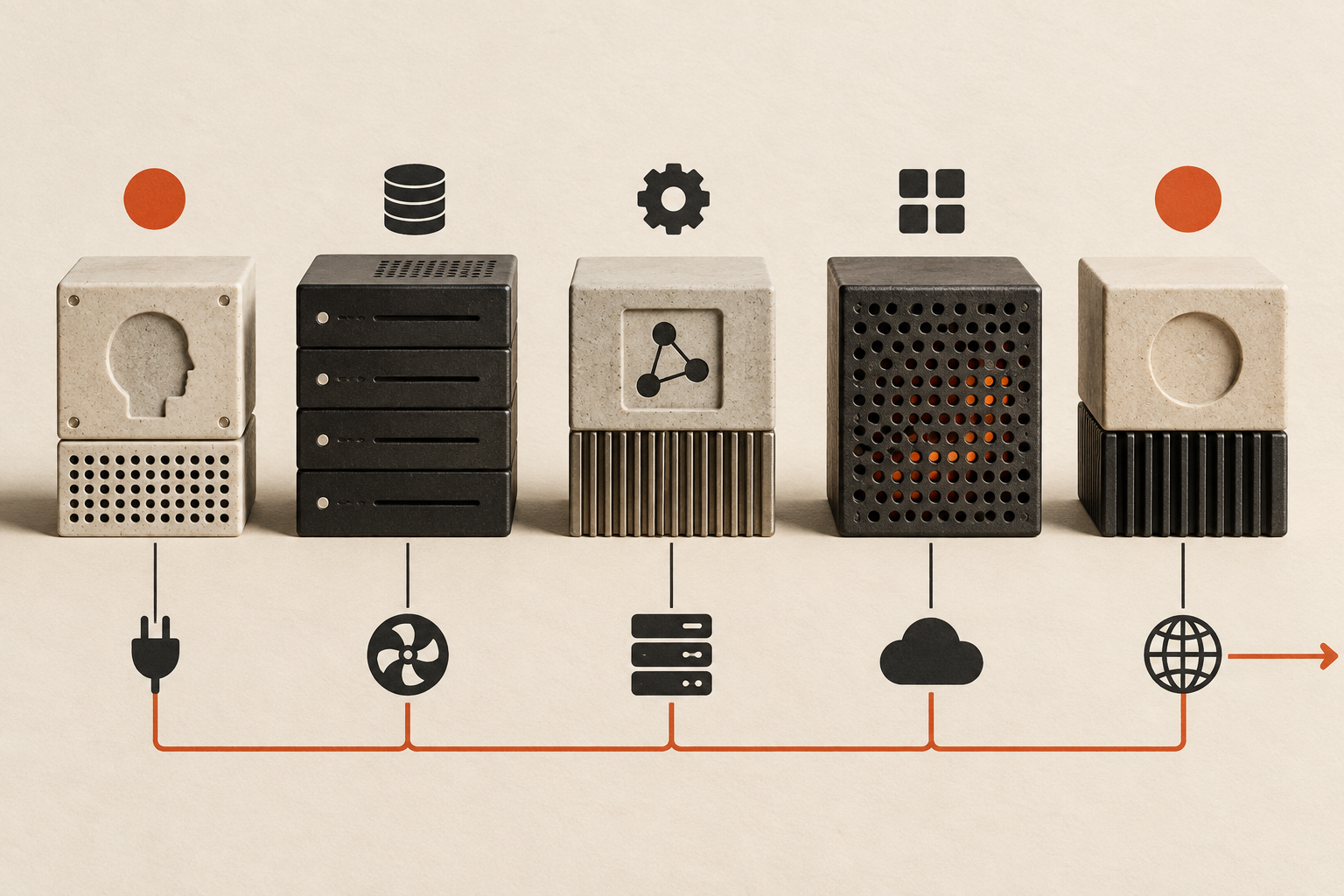
Five sculptural server-like modules on cream paper, linked by an orange line that continues beyond the frame.

YouTube

Fireship’s five-tool AI stack, explained

Ollama, 9Router, Headroom, Dify, and OpenHands handle five different jobs: running models, connecting AI services, shrinking inputs, building app workflows, and assigning coding tasks to an agent that writes and changes code. Here is what Fireship’s self-hosted setup offers—and which costs still need a budget.

A stack of instruction slips rises past a low ceiling bar, with four cards failing in different ways.

YouTube

Is the 200-instruction skills ceiling still real?

Laurie Voss traces the ~200-instruction “agent starts forgetting” figure to a 2025 aside from Dexter Horthy, then reruns an IFScale-style keyword-inclusion test. Last year’s remaining models still fell apart around 200–300 named constraints. The then-current frontier, in his run, walked through 500 required words and held until roughly 2,000 (best around 5,000). That is his claimed ~10x jump, not a product spec and not a Radar rerun. Longer skills files are now plausible; the live problem is that models fail in four different ways, and a plausible answer can still be incomplete.

Claude Radar brief card: Claude Code cloud sessions are out of research preview, ClaudeDevs says

X

Claude Code cloud sessions are out of research preview, ClaudeDevs says

On 23 September 2026, the X account ClaudeDevs said Claude Code cloud sessions are officially available and out of research preview. The same post said they keep Claude Code working after the laptop is closed. Anthropic’s docs define a cloud session as a Claude Code session on remote infrastructure that keeps running after you close the laptop and can be checked or steered from any device. Those pages list the feature on Pro, Max, and Team plans, and for Enterprise users with premium seats or Chat + Claude Code seats. Cloud sessions share the account’s rate limits. ClaudeDevs also offered existing subscribers a one-time credit of $100 on Pro or $250 on Max: one per account, for cloud sessions only, to claim by Oct 7.

Claude Radar brief card: Claude Opus 5.5 is in Claude Code, with a seed-based drawing demo from Anthropic

X

Claude Opus 5.5 is in Claude Code, with a seed-based drawing demo from Anthropic

Anthropic’s Claude account said Claude Opus 5.5 was available on 22 September 2026, showing an algorithmic drawing program credited to @kevin_t_ngo. Claude Code’s changelog lists Opus 5.5 as the default Opus model, with a 1M context window and a $4/$20 per Mtok pair plus $0.20/Mtok cache reads.

From the magazine